
Picture yourself in a movie theater. The Fremen raise their weapons and chant in a strange tongue. The subtitle reads: “Long live the fighters!”
But in the original novel, published in 1965, the chant was not nearly so strange. It was written like this: Ya hya chouhada.
Say it out loud. If you are from the Maghreb, an echo you know well will come to mind: Long live the martyrs.
This is no linguistic accident. And this small phrase opens the door to a larger question: how did a piece of our collective memory find its way into one of the most celebrated epics in science fiction, and why did it not reach the screen as it was?
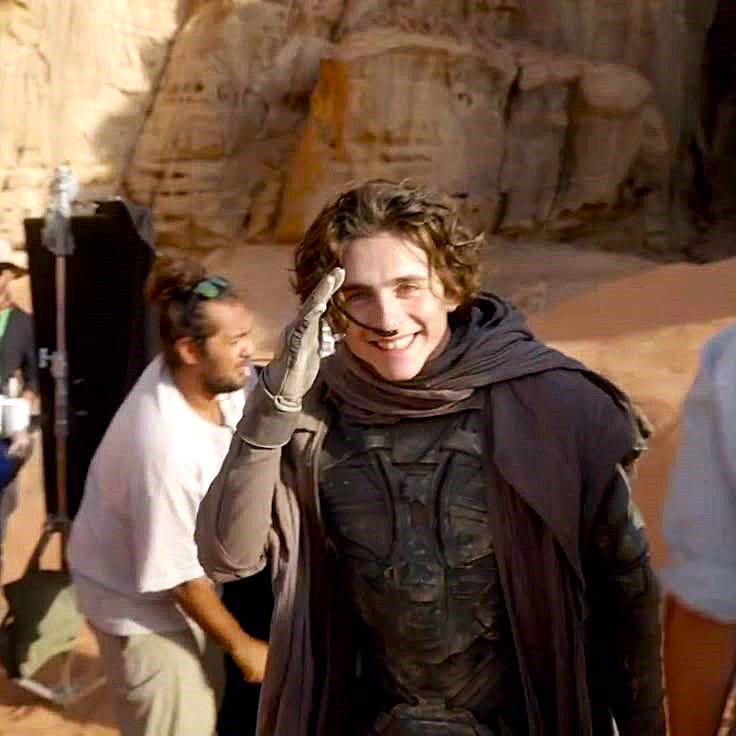
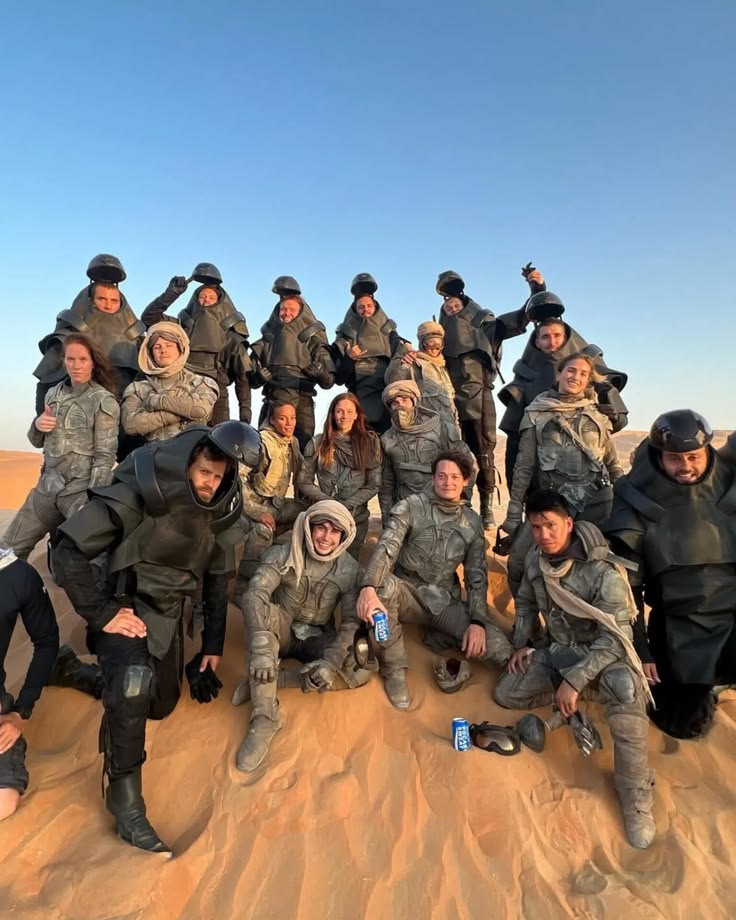
A Chant from the War of Independence… in an American Novel
Frank Herbert was an American writer, and his novel unfolds thousands of years from now, in a distant galaxy. Yet the anthropologist Manvir Singh, a professor at the University of California, Davis, writes in his widely read New Yorker essay on the invented languages of Dune that the phrase echoes a celebratory chant from the Algerian War of Independence, which Herbert rendered in a French-inflected spelling.
Recall that Algeria won its independence in 1962, just three years before the novel appeared. The world was still following the revolutions that were driving out the old empires, and Herbert was writing about a desert people whose land and only treasure were being exploited by a great power.
The point is clear: the Fremen are not merely “strange inhabitants.” They are a people in resistance, and the language of their resistance is borrowed from a real one.
Not Just One Word
The Algerian chant is the most famous example, but it is far from the only one.
The name Mahdi appears in the novel, as does Lisan al-Gaib, the title given to Paul Atreides. Even the Butlerian Jihad, the celebrated war against thinking machines in the novel’s history, carries a word of Arabic origin in its name.
As for “Muad’Dib,” the name by which Paul becomes known among the Fremen, it was studied by Karin Ryding, professor emerita of Arabic at Georgetown University, in a chapter titled “The Arabic of Dune.” As quoted in The New York Times, the name is close to an Arabic word meaning “teacher.” In the novel itself, it is also the name of a desert mouse native to Arrakis.
It means Herbert did not sprinkle a few Arabic words over his story for decoration. He used them to build an entire layer of religion, prophecy, and survival in the desert.
Why Did the Chant Disappear from the Film?
In Dune: Part Two, the chant is spoken in Chakobsa, a constructed language created for the films by the linguist David J. Peterson.
Peterson’s argument is easy to understand: if the story takes place ten thousand years from now, it makes little sense for contemporary Arabic to survive unchanged. Languages evolve until they become unrecognizable.
The critics answer with a different argument. The scholar Haris Durrani, who has written on Dune’s relationship to Islamic history, argues that removing the Algerian chant erases a specific historical inspiration on which Herbert drew. In his view, the novel’s brilliance lies precisely in our ability to recognize traces of our own past within it, not in the future being wholly alien.
In simpler terms: Peterson wants a world that is coherent from within, while Durrani and Singh want a world that remembers where it came from.
The irony is that some words did survive. According to Variety, “Mahdi” and “Lisan al-Gaib” can still be heard in the script of Part Two. In other words, the films kept from Arabic whatever lends the story the aura of prophecy, and left out what ties it to a real act of resistance.
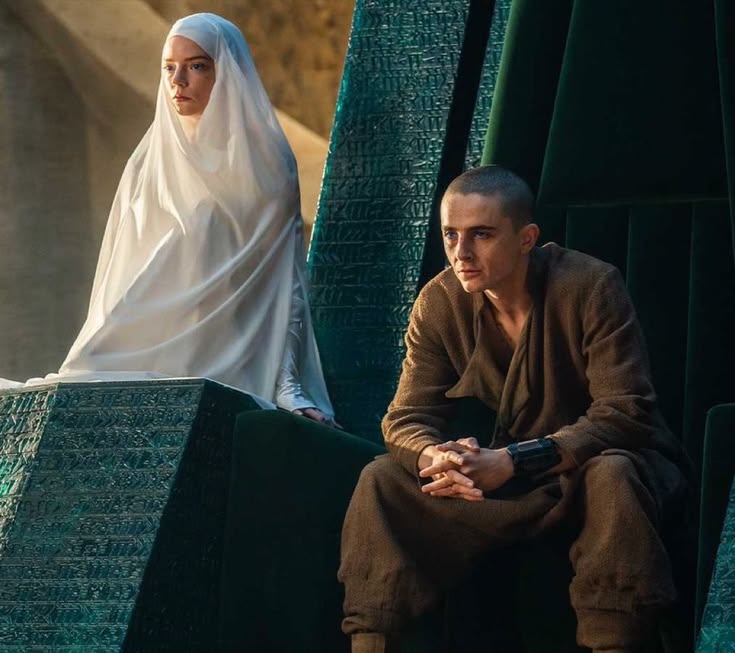
The Desert Is Present… and the Arabs Are Out of Frame
The debate was never only about language.
Parts of the film were shot in Jordan and Abu Dhabi, and its visuals carry features, costumes, and symbols reminiscent of the region. Yet in March 2024, Variety reported criticism from people working in casting about the thin presence of Arab and North African actors in speaking roles.
Serena Rasoul, founder of the casting company MA Casting, called it “a missed opportunity to honor the region’s rich culture and heritage.” Amani Al-Khatahtbeh, founder of MuslimGirl, pointed to a familiar contradiction: when a production needs a Middle Eastern villain, the actors are easy to find; when the roles are positive, the conversation turns to a shortage of talent.
Reports note that the actress Souheila Yacoub, of Tunisian heritage, was the most prominent exception among the speaking Fremen roles.
In fairness, the director Denis Villeneuve has previously defended his choices, saying he tried to remain faithful to the images the book had formed in his mind. But the critics’ question is not about his intentions. It is about the outcome: who has the right to appear within a story that drew on their culture?
And Paul? The Hero Herbert Wanted Us to Fear
Here the debate grows deeper.
It is easy to read Dune as the story of a young outsider who arrives among an oppressed people and leads them to victory. But Herbert said on several occasions that he intended the opposite: to warn readers against the leader whom people follow without question.
That is why, after the first novel, he wrote Dune Messiah, in which the cost of that leadership becomes plain.
And that is exactly what Dune: Part Three will present. It is scheduled for release on December 18, 2026 (and from December 16 in some countries). The film is adapted from Dune Messiah, and according to the official synopsis, it is set nearly two decades after Paul seizes the empire. He is now a ruler haunted by visions of his empire’s collapse, while Chani stands at the heart of a conspiracy closing in around him.
The irony is harsh: a story that warns against the messiah is being told after some of what tied the Fremen to a real resistance has been cut away. That does not make the film worthless, but it does mean the questions Part Two ignored are still waiting to be asked.
What Does All This Mean for Us?
We should not read Dune as “our story.” Herbert drew on many sources, from the dunes of Oregon to the history of empires and religions, and then built an imaginary world of his own.
But it is not an exaggeration to ask the question in return: when our names, symbols, and chants are borrowed, do we have the right to be part of the story?
The other question is harder: how many imaginary worlds have we built ourselves, in our own language and memory, so that the world might one day search them for our traces?
Perhaps the Algerian chant on Arrakis is not merely a charming footnote. Perhaps it is a small invitation to us: to write our own stories before someone else writes them for us.
So if you watch Part Three this month, listen closely to the words. Which of them are still Arabic? Which have disappeared? Tell us in the comments.
Sources
- Manvir Singh, “Dune and the Delicate Art of Making Fictional Languages,” The New Yorker, 2024.
- Karin Christina Ryding, “The Arabic of Dune,” and her remarks as quoted in The New York Times.
- Haris Durrani, commentary and writings on the Islamic and Algerian roots of Dune.
- Variety, “Dune 2 Criticized for Lack of Middle Eastern and North African Inclusion and Influences,” March 2024.
- Official Warner Bros. materials on Dune: Part Three (synopsis and release date).
- Oregon Encyclopedia, entry “Herbert, Frank, and the Dune Series,” on Herbert’s 1957 trip to Florence.